

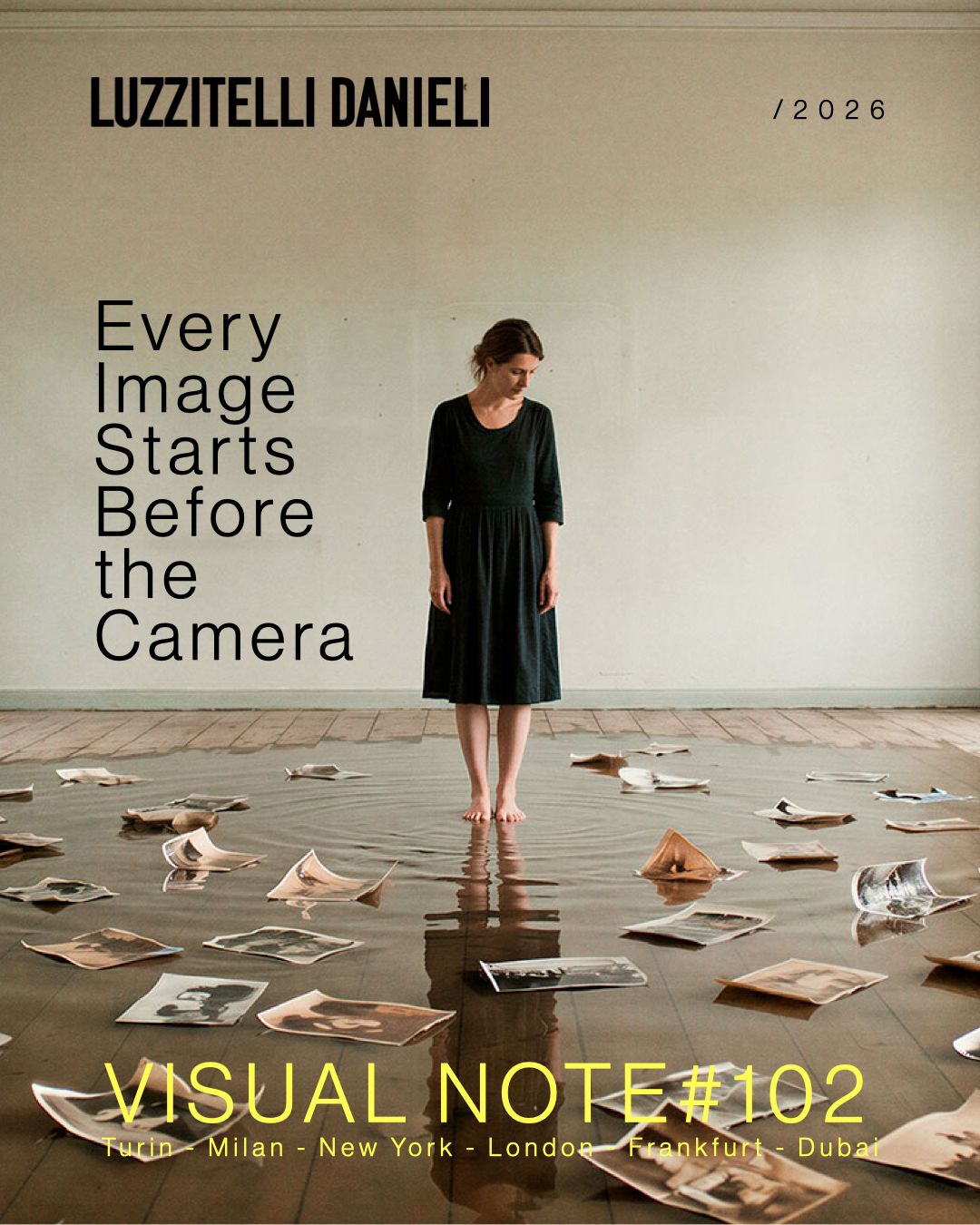
Every Image Starts Before the Camera
Why creative direction matters more than the production method.
The visual industry often focuses on technology. Every year, new cameras, rendering engines and Artificial Intelligence platforms promise to transform the way images are created. The tools are becoming faster, more powerful and more accessible. But technology has never been the starting point. The starting point is the image itself. Before choosing a camera, building a 3D scene or generating an image with AI, there is a more important question: What should this image communicate? That question defines everything that follows.
The Image Comes Before the Method
A camera does not create an idea.Neither does a rendering engine. And an AI model cannot replace a visual intention. They are production tools. The creative decision comes first. A product may need to feel luxurious, precise and tactile. A pharmaceutical campaign may need to communicate trust and scientific credibility. An automotive image may need to express performance, engineering and movement. A lifestyle campaign may need to create identification and emotional connection. The objective changes. The production method can change with it. This is why we don't begin a project by asking:
"Should we photograph this or create it in CGI?"
We begin by asking:
"What is the right image for the idea?"
Only after that decision do we determine how the image should be built.
Il tuo contenuto va qui. Modifica o rimuovi questo testo inline o nelle impostazioni Contenuto del modulo. Puoi anche definire lo stile di ogni aspetto di questo contenuto nelle impostazioni Design del modulo e persino applicare CSS personalizzato a questo testo nelle impostazioni Avanzate del modulo.
Creative Direction Defines the Purpose
Creative direction is often associated with moodboards, references and visual styling.
It is much more than that.
Creative direction establishes the principles that determine how an image should look, feel and communicate.
It defines:
- composition
- lighting
- colour
- materials
- perspective
- atmosphere
- movement
- human presence
- level of realism
- visual tension
- relationship between product and environment
These decisions create a visual language.
Once that language is defined, production becomes a matter of execution, refinement and control.
Without direction, technology produces possibilities.
With direction, technology produces an image.
Photography Is a Production Method
Photography remains one of the most powerful ways to create visual content.
It captures real materials, real environments, real people and real physical interactions.
But photography also has limitations.
A specific environment may be difficult to build.
A particular lighting condition may not exist.
A product may not yet be available.
A physical setup may be technically possible but commercially inefficient.
This is where creative direction becomes important.
The question is not whether photography is better than CGI or AI.
The question is whether photography is the right production method for the image we need to create.
Sometimes it is.
And when it is, the physical production is directed with the same precision applied to every other medium.
CGI Expands the Physical World
CGI allows us to construct images that would otherwise be difficult or impossible to produce physically.
Products can be visualised before they exist.
Environments can be designed from scratch.
Materials, reflections and lighting can be controlled with extreme precision.
A single digital asset can also generate multiple visual variations without rebuilding an entire physical set.
But CGI is not valuable simply because it is digital.
Its value comes from the control it provides.
The challenge is not creating a technically perfect render.
It is creating an image that feels intentional, believable and connected to the visual identity of the brand.
Artificial Intelligence Changes the Production Process
Artificial Intelligence introduces another layer of possibility.
It can accelerate visual exploration, generate alternative directions, help develop environments and allow concepts to be tested before committing to a traditional production.
But AI also creates a new problem:
too many possibilities.
Generating an image is increasingly easy.
Knowing which image deserves to exist is not.
This makes creative direction even more important.
AI can generate thousands of visual outcomes.
Creative direction determines which one belongs to the brand.
One Project. Different Production Methods.
The most interesting projects are not necessarily built using a single technology.
Photography, CGI and Artificial Intelligence can coexist within the same production.
A real product can be photographed and placed inside a digitally constructed environment.
A photographic background can be extended through CGI.
A CGI object can be integrated into a real environment.
AI can be used during concept development while photography and CGI remain the final production methods.
The boundaries between disciplines are becoming less relevant.
What matters is the final visual result.
Hybrid Production Is About Control
Hybrid production is sometimes presented simply as a way to reduce production costs or create content faster.
Those can be advantages.
But they are not the fundamental reason we use it.
The real advantage is control.
Control over:
- light
- environment
- materials
- perspective
- composition
- scale
- atmosphere
- variations
- visual consistency
A hybrid workflow allows us to decide which elements should remain physical and which should be constructed digitally.
The result is not "half photography and half CGI."
It is a single image built through multiple production methods.
Consistency Becomes More Important as Brands Grow
A single image can be successful on its own.
A visual system has a more difficult task.
It must remain coherent across multiple campaigns, products, markets and communication channels.
This is where production methodology becomes strategic.
If one image is photographed, another generated with AI and another created entirely in CGI, they should still feel like they belong to the same brand.
The same principles of:
light, composition, colour, material behaviour, perspective and atmosphere
must remain recognisable.
Technology can change from image to image.
The visual language should not.
From Brief to Final Image
At LuzzitelliDanieli, the process begins before production.
01 — Define the intention
What should the image communicate?
What should the audience feel?
What role does the image play within the campaign?
02 — Establish the visual direction
We define references, composition, atmosphere, lighting, materials, colour and visual behaviour.
03 — Choose the production method
Photography, CGI, Artificial Intelligence or a combination of them.
The method follows the visual objective.
04 — Build the image
Production begins with the established direction as its framework.
05 — Refine and control
Post-production, compositing, colour and detail are used to bring every element into the same visual system.
06 — Deliver a coherent visual asset
The final image is not simply technically finished.
It belongs to a larger visual language.
The Tool Should Never Become the Story
There is a tendency to celebrate the technology behind an image.
"This was made with AI."
"This was rendered in CGI."
"This was shot with a particular camera."
Those details can be interesting.
But they are not the reason an image works.
A viewer does not remember a photograph because of the camera used to create it.
They remember the image because of what it communicated.
The same principle applies to CGI and Artificial Intelligence.
Technology should enable the image, not become the image.
Creative Direction Before Production
The evolution of visual technology does not make creative direction less important.
It makes it more important.
When production becomes easier, the number of possible images increases.
When the number of possibilities increases, selection becomes more difficult.
And when selection becomes more difficult, intention becomes essential.
This is why we believe that the future of visual production is not about choosing between photography, CGI and AI.
It is about knowing when, why and how to use each of them.
One Creative Direction
Photography.
CGI.
Artificial Intelligence.
Different technologies.
Different production methods.
One creative direction.
At LuzzitelliDanieli, we don't define our work by the tool used to create an image.
We define it by the quality of the visual decision behind it.
Because the best production method is not necessarily the newest one.
It is the one that creates the right image.
Every Image Starts Before the Camera
The camera is sometimes the beginning of production.
But it should never be the beginning of the idea.
The same applies to a render.
The same applies to an AI prompt.
Every image begins with an intention.
A question.
A decision.
A direction.
Only then does production begin.
The technology may change.
The visual intention should not.